The One-Day Clean-Up That Tries to Fix Everything
A one-day clean-up works better when it tackles one clear task. Set a visible boundary, guide volunteers and record other issues for follow-up.
A one-day clean-up can leave a path clearer, but it cannot sensibly become a litter pick, repair session and planting project all at once. A successful clean-up starts with a defined patch of ground and one kind of work, so volunteers know what belongs in the task and what needs another arrangement.
A clean-up needs a visible boundary
Name the place with landmarks people can recognise: the path between the library entrance and the bus stop, for instance. Then state the activity and the point where it stops. “Collect loose litter from the paved path between the library entrance and the bus stop” is easier to act on than “sort out the park”.
Make exclusions just as clear. Collecting litter does not automatically include pruning shrubs, moving abandoned objects, washing furniture or repairing a sign. Those jobs can involve different permissions, equipment or skills. Leaving them aside keeps the clean-up focused; it does not mean the issues have been forgotten.
A clear boundary also makes the invitation honest. Say that volunteers will collect loose litter from the named path, rather than promising to improve the whole park. Neighbours can decide whether the task suits them, and the group has a fair way to tell when its work is complete.
Separate jobs need separate arrangements
Extra aims bring extra questions. Painting may require agreement about the surface and materials. Planting involves decisions about what suits the site and who will care for it. A public fixture may belong to a council or another land manager, while a repair could call for a qualified tradesperson. Even sorting a noticeboard can raise questions about who may remove notices.
Combining all of this makes the plan harder to explain and the work harder to coordinate. Someone arriving ready to pick up litter may instead find a request to scrub, plant or repair. A clean-up can then end with several partly started jobs rather than one finished task.
Keep a separate note of anything outside the agreed work. A damaged sign, blocked drain or worn bench can be recorded for later attention without asking volunteers to investigate or fix it. The organiser can then decide who owns the issue and whether it needs a report, permission or a separate project.
Agree the scope and arrangements before inviting volunteers
Describe the work in one sentence: name the place, the action and any important exclusions. Check that the site is accessible to the people you hope will attend, decide where collected material should go, and name someone who can answer questions on the day.
- Place: If volunteers can identify the start and finish from a landmark, use those points in the invitation; if they cannot, choose clearer landmarks or provide a simple site description.
- Task: If the work is limited to loose litter, say so; if the plan also includes another activity, arrange and describe that work separately.
- Permission: If the task touches a public fixture, planted area or managed site, contact the responsible council team, land manager or community organisation first; if permission is unclear, leave that work out.
- Equipment: If the required tools and materials are available and appropriate for the agreed task, explain how they will be provided; if not, revise the plan rather than inviting people to improvise.
- Collected material: If the group has an agreed handover point for filled bags, tell volunteers where it is; if there is no agreed destination, ask the site manager before the session.
- Out-of-scope issues: If a volunteer spots an unfamiliar object or a repair, direct them to the named organiser and record the concern; if it requires specialist or safety-critical work, keep volunteers clear and refer it to the responsible service or an appropriate professional.
Follow local requirements and the instructions for any materials or equipment. If the work calls for specialist knowledge or safety-critical action, leave it to an appropriate professional.
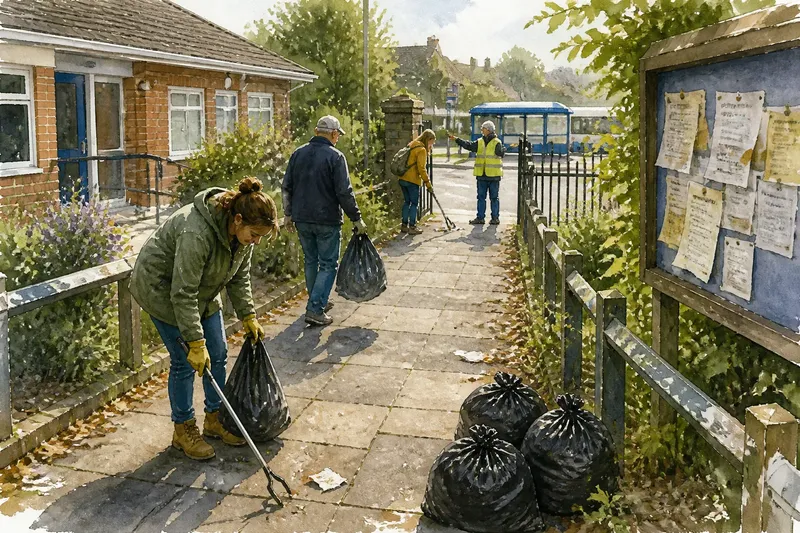
Say you are arranging a Saturday clean-up beside a community hall. The starting point is a paved entrance path with scattered wrappers and leaves, and the hall caretaker has agreed to take the filled bags at a named handover point. You write the task as collecting loose litter from the path to the gate, tell volunteers that planting and repairs are excluded, and repeat the boundary when they arrive. They collect litter within that route and leave the bags for the caretaker; the visible result is a clearer path and a known handover, while the peeling rail and crowded noticeboard remain matters for a separate decision.
Keep the volunteer briefing focused
The invitation should state what volunteers will do, where to meet, what to bring if anything, and whom to ask if they are unsure. Avoid describing a broad transformation when the session has one specific purpose.
At the start, point out the route and its stopping place. Explain the group’s arrangements for ordinary litter, and identify the organiser who can handle anything outside the task. Volunteers then have a clear person to ask instead of being left to make up a response around an unfamiliar object or public fixture.
When an unrelated issue appears, record what was noticed and where. If appropriate, note which body or person is responsible for the site. Recording is not a promise to fix it: the group can later decide whether to report it, seek permission for a new project or leave it with the responsible service.
Finish the agreed work before choosing another project
Once the group reaches the stated boundary, check the agreed area together and note what was completed. If a small extension was already included in the plan, the organiser can decide whether to proceed; spare time alone is not a reason to begin unrelated work.
Say the litter pick is complete but volunteers notice a loose rail. The group records its location and the site manager to contact, then finishes the clean-up instead of attempting a repair. The result is one completed task and a clear follow-up decision, rather than an improvised job that may need different permission or skills.
Future sessions can take on other concerns with their own purpose and arrangements. A separate planting day or noticeboard tidy can involve the people responsible for the site from the outset. Keeping projects distinct gives residents a clearer choice about what they are volunteering to do.
How should a one-day clean-up handle common questions?
How do you choose a useful clean-up boundary?
Use landmarks volunteers can find when they arrive, then name the stopping point. If the boundary is difficult to describe, give a clearer site description before inviting people.
Should a clean-up include small repairs?
Include a repair only when it has been separately agreed and appropriately arranged. If permission or specialist skill is needed, record the issue and take it up with the responsible person instead.
What should organisers do with unrelated problems?
Write down what was noticed and where, then identify the responsible person or service where possible. Decide later whether to report it or arrange a separate project rather than adding it informally to the clean-up.
How can volunteers tell when the task is finished?
State the end point in the invitation and show it at the start. A task that ends at a named gate is complete there, even if other problems remain elsewhere in the neighbourhood.
A one-day clean-up is easier to organise when its promise stays modest and precise. For a litter pick, a named route, a clear handover for collected bags and a place to record other concerns are enough to distinguish finished work from the next project.