A First Volunteer Morning: A Plan with Room to Breathe
Plan a first neighbourhood volunteer morning with a clear meeting point, one welcoming task and clear arrival details, so newcomers can join with confidence.

A newcomer who reaches the library side entrance should be able to spot the group, understand the task and know how to begin. A first neighbourhood volunteer morning depends less on a packed schedule than on clear hand-offs: from invitation to arrival, and from arrival to useful participation.
Think of the session as a small piece of local hospitality. The organiser’s job is to remove guesswork, explain the shared work and make room for people who prefer to listen before joining in. That approach helps newcomers feel oriented without turning them into an audience or expecting them to tell their story.
A first neighbourhood volunteer morning starts with a recognisable welcome
Choose a public meeting point close to the activity and describe it so someone unfamiliar with the area can recognise it. “Outside the library’s side entrance, beside the green litter bin” gives a newcomer more to look for than “near the centre”. Mention which side of the building and whether the group will move elsewhere.
Make the gathering visible. A hand-written sign, a bright clipboard or an organiser in a named-colour coat can help someone identify the group without recognising anyone’s face. If the group will move to a garden or hall, say where and how to follow.
Consider the approach as well as the landmark. A narrow pavement, steps or a crowded doorway can make an otherwise obvious spot difficult to use. If the entrance is awkward, choose a nearby place with a level approach and enough room to gather without obstructing passers-by.
Choose a task newcomers can understand by watching
A good first task has visible materials, a simple demonstration and a natural point at which someone can stop. Sorting donated books into labelled trays, preparing event labels at a table or watering a set of planters with supplied equipment can all work when the group has permission and the practical arrangements in place.
Show what “done” looks like. Instead of asking someone to “help with the garden”, point to the marked planters and explain which ones need watering. Put labels, trays or other supplies where people can reach them, and identify a straightforward starting point.
Describe the physical setting honestly. Say whether the activity is indoors or outside, whether people will be standing, and what the group provides. Where possible, offer a choice such as seated sorting or a standing task. For work involving tools or a potentially hazardous site, choose a different beginner activity unless a suitably qualified person is organising and supervising it.
Give the session a shape people can plan around
Include a start and finish time in the invitation, then protect the finish as part of the plan. People may have work, care responsibilities or another appointment; they should not have to guess whether “morning” means an hour or an open-ended shift.
Leave room for arrivals, a brief welcome, a demonstration and a shared closing. If the task finishes early, use the spare time to put materials away and explain what happens next. Do not invent another job simply because people are still there.
Decide beforehand what counts as enough for this gathering. That might mean preparing the materials already laid out or watering the agreed planters. If some work remains, name who will decide what happens next; do not let an unfinished task quietly become a new obligation for newcomers.
Put the useful details in one invitation
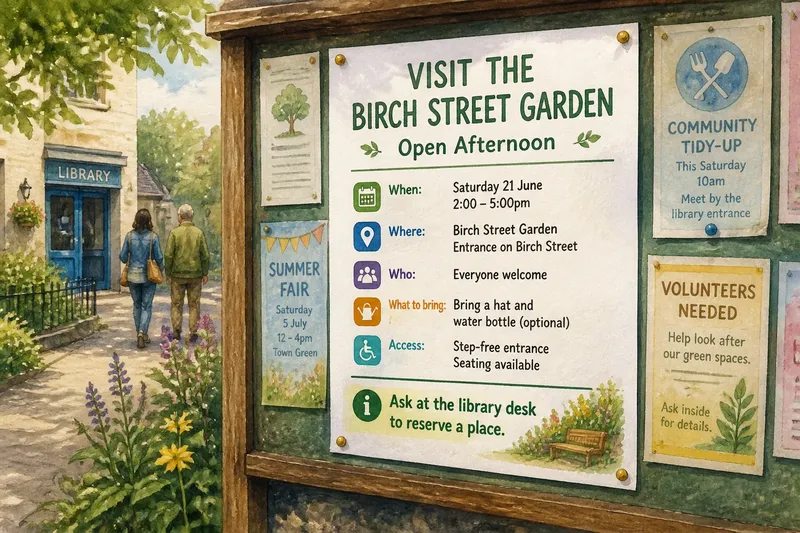
Use a community noticeboard, email or local group message, but keep the essential information together. People should be able to decide whether to attend without chasing several posts for the basics.
- Meeting point: If the location could be confused with another entrance, add a landmark and the exact side of the building; otherwise, keep the description brief.
- Task and setting: If the work is outdoors or involves standing, say so; otherwise, describe the indoor activity plainly.
- Times: If someone needs to leave for another commitment, the stated finish lets them plan; if the timing depends on a venue opening, confirm that arrangement before inviting people.
- Materials: If gloves, labels or other supplies are provided, name them; if people need to bring something, say exactly what and why.
- Access and questions: If a person may need a different way to take part, offer a contact route before the day; if the task cannot accommodate a particular request, explain the limit honestly and consider another role.
- Weather plan: If the activity depends on dry weather, state where a cancellation or change will be posted; if there is an indoor alternative, give its location.
- Late arrival: If the group may move, include a contact method and destination; if it will remain in place, say so to prevent unnecessary searching.
Avoid relying on local shorthand. A new resident may not know the name of a community garden, and a parent may need to ask whether children can attend. Check venue rules and the organiser’s arrangements before describing who can take part.
Welcome people without making them perform
Greet each arrival, give your name and explain where the task begins. A newcomer can watch first, ask a question or choose a quiet role. Do not require a round of personal introductions or an explanation of why someone came.
Offer one instruction at a time. Show where materials belong, who can answer questions and how to pause if something is unclear. Then give people space to work. A nearby organiser can help without hovering or filling every silence.
Explain what happens to completed work. A sentence about where the sorted books will go gives the task context without requiring a full account of the project’s history. If someone finishes, point out the agreed stopping point or offer an optional next task rather than silently extending their workload.
Late arrivals and early departures need no fuss
Keep a simple catch-up ready for anyone who misses the welcome: what the group is doing, which materials remain available and where to start. If the group has moved, make sure the contact route in the invitation still works.
Normalise leaving at the stated finish, or earlier if someone needs to. Show where shared items go and say goodbye without asking for a reason. A volunteer’s private commitments are not a group discussion.
Say you are organising a book-sorting session for a community cupboard. You lay out labelled trays for usable and damaged copies, demonstrate where each book goes, and tell everyone that the session ends when the prepared stack is sorted or the stated finish arrives, whichever comes first. A newcomer arrives after the welcome, gets the same brief explanation and starts at an empty tray; another leaves early and returns a shared pencil to the marked table. The visible result is that each person can join or leave without stopping the group or guessing what to do.
Close the gathering with a clear hand-off
Give a short warning before the finish, then ask people to return materials to their marked places. Keep tidying proportionate to the activity; do not attach a surprise clean-up or extra task as people are preparing to go.
Thank people for a specific contribution and say what happened to the work. If something remains, name who will decide what to do next. This keeps unfinished work from sounding like a debt newcomers have inherited.
For a venue-based activity, follow the organiser’s arrangements for access items and leaving the space. Before everyone disperses, check that the meeting area is clear and shared materials are accounted for.
What should organisers check before inviting newcomers?
Can someone find the meeting point?
Check the invitation against the actual entrance and landmark. If a first-time visitor could confuse it with another spot, add a precise location and a way to recognise the group.
Can the task be understood at a glance?
Set out the materials and practise explaining the first action in plain language. If the explanation needs a long briefing, simplify the task or prepare a short demonstration before inviting people.
What happens if the group moves or the weather changes?
Choose a contact method and a place to post changes before the invitation goes out. If there is no suitable alternative location, say how and when people will be told that the session is cancelled.
How will a newcomer know the session has ended?
Set a finish time and a stopping point, then include both in the invitation. If the task remains incomplete at the finish, stop and name who will decide what happens next.
A follow-up should leave the next choice with the volunteer
Send a brief note through the invitation channel. Thank people, say what the group completed and share a next date or decision point only if one is settled. If there is no further gathering planned, say so rather than implying that a regular schedule exists.
You can ask whether the meeting point was easy to find or the instructions were clear, while making a reply optional. Use any feedback to improve the next welcome, not to judge how keen someone seemed.
A first neighbourhood volunteer morning succeeds when someone unfamiliar with the group can find the gathering, understand the task and take part on clear terms. Before the next invitation goes out, check the exact entrance once more: a small correction to the meeting description can save a newcomer from standing alone at the wrong door.