Before the Group Chat: How Neighbourhood News Found Its Readers
Neighbourhood news once travelled by voice, print and local institutions. Trace those routes to understand how communities built shared memory and belonging.
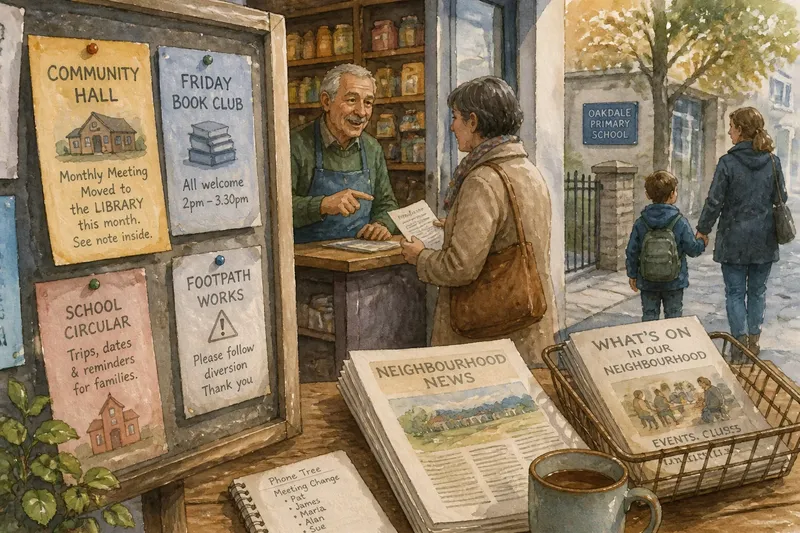
Before the group chat, neighbourhood news travelled through familiar places and local institutions: a shop counter, a school gate, a parish newsletter or a community hall. Those routes did more than deliver updates; they helped neighbours recognise what mattered locally and who could explain it.
Looking at that history reveals a civic role often missed in advice about choosing communication channels. Local information was part of the texture of shared life, shaped by routines, trust and access to public places.
Shared places made local news visible
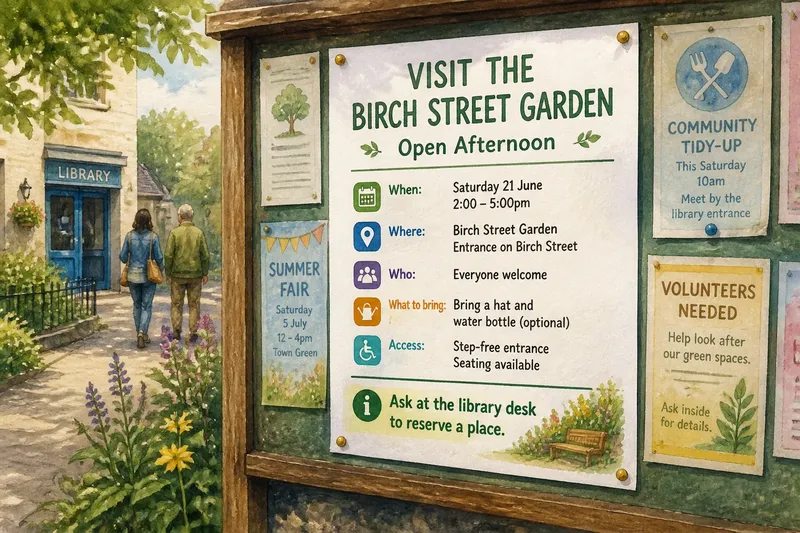
A notice pinned beside a library entrance or mentioned after a club meeting appeared within an existing routine. People encountered it while doing something else, rather than seeking out a separate source of neighbourhood news.
The place also supplied context. A message about a hall carried meaning for people who used the hall; a school circular spoke to families linked to the school. These settings made some information feel relevant, but they also set boundaries. People outside the institution’s usual circle could miss it.
Local venues were not neutral containers. A building’s opening hours, entrance arrangements and management shaped who could see or use the information there. A notice on a locked hall door, for example, could be less useful than one displayed at a nearby library that visitors could enter during its public hours.
Local intermediaries gave news a human voice
Shopkeepers, caretakers, club organisers and other familiar figures often helped information travel. Their role was not simply to repeat words. They could explain a local nickname, clarify which room was meant or direct someone to the person responsible.
That personal help had limits. A detail might be forgotten as news passed from one person to another, and people who did not know the messenger might not hear it at all. The route depended on relationships as much as on the message itself.
Say an invented residents’ association learns that a monthly meeting will move from its usual room to the library. A caretaker tells regular hall visitors and points to a dated note at the hall entrance naming the library. The expected result is that regulars hear the change in conversation, while anyone arriving later can check the written information rather than relying on memory.
Print created a record people could revisit
Leaflets, circulars and local newsletters gave information a more durable form than conversation. Readers could keep a paper and return to a date, venue or contact detail. A printed item could also travel home with someone who had encountered it at a school, library or community event.
Print brought its own constraints. A publication’s schedule might be too slow for a sudden change, and a notice could remain on a wall after its information had expired. The record was only useful if people could find it and tell whether it was current.
Communities also used telephone trees, local newspapers and community radio. Each fitted a different rhythm: a phone call could prompt a direct response, while a newspaper or radio announcement depended on when people encountered it. These were not interchangeable tools so much as different parts of local civic life.
Different routes reflected different kinds of belonging
Information moved along networks formed around schools, places of worship, residents’ groups, markets and clubs. Someone connected to several of these places might carry news between them. Someone with no link to those institutions could remain outside the flow.
This helps explain why a message reaching a familiar circle was not necessarily common knowledge. The issue was not simply whether the wording was clear; it was also which relationships and routines connected people to it. Local news depended on social ties that could bring neighbours together while leaving others at the edge.
The same distinction matters when interpreting old community records. A leaflet or notice tells us what its authors chose to circulate and where they expected readers to be. It cannot, by itself, tell us who actually saw it or how people outside the named audience understood the issue.
How did neighbourhood news move?
Why did local institutions carry news?
Schools, libraries, halls and clubs already brought people together, giving organisers a place to share information. Their reach followed membership and access, so people outside those circles could be missed.
What made word of mouth useful?
A familiar person could explain a detail that a short notice left unclear. The message could also change as it passed between people, making a written record useful for details that needed to stay consistent.
What did printed notices add?
Print gave readers a version they could keep and revisit, rather than relying on memory. It worked best when the item was easy to find and clearly current; an old notice could mislead just as readily as a misremembered conversation.
Why could some neighbours be left out?
People did not all visit the same venues, belong to the same organisations or know the same local intermediaries. A channel’s reach followed those connections, not an assumption that everyone shared one routine.
Old communication routes reveal local priorities
Where a community placed its notices and who was asked to pass them on can show which places and relationships carried civic weight. A school circular suggests a family audience; a hall notice points towards people who used that building. Neither source proves that every intended reader received the message.
For anyone tracing neighbourhood history, read the medium as well as the words. Note who issued the item, where it appeared, which people it addressed and whether it gave readers a way to respond. That context makes the record more revealing without turning an incomplete archive into a complete picture of community life.
Neighbourhood news before the group chat was sustained by people, institutions and places working together, unevenly. The most useful question is not only what a message said, but what local route made it visible—and whose everyday route never crossed its path.